Salesforce proof path
$20B+
Salesforce is the live wedge: field stripping, live record checks, governed writes, and audit evidence against real enterprise permissions.
Comparison
By 2026 every major vendor has a cross-system story. The question is whether one vendor becomes the center of gravity, or whether the enterprise gets a governed layer above the systems, surfaces, workflows, and models it already chose.
| Feature | AIGIS governed.dev | Agentforce Salesforce | Now Assist ServiceNow | Joule SAP | Copilot Microsoft |
|---|---|---|---|---|---|
| Enterprise center of gravity | Neutral control plane | Salesforce | ServiceNow | SAP | Microsoft |
| Cross-system requests natively | Salesforce today; SNOW + SAP co-dev | via MuleSoft | via Control Tower | via Joule Studio | via 100+ connectors |
| Production connector maturity | Salesforce live; ServiceNow and SAP design-partner co-development | Salesforce-native | ServiceNow-native | SAP-native | Microsoft-native |
| Without buying a separate integration platform | Partial | ||||
| Chat/work surface choice | Slack, Claude, Teams, OpenAI, SF LWC | Salesforce-first | ServiceNow-first | SAP-first | Microsoft-first |
| Model choice per request | Full router | Salesforce-mediated | Platform-mediated | SAP-mediated | Microsoft-mediated |
| Can answer without an LLM call | Cache / API / SQL / workflow | Limited | Limited | Limited | Limited |
| Field stripping (architectural, not masking) | |||||
| Permission re-check at write time | Partial | ||||
| Human-in-the-loop writes | Limited | ||||
| Permission provenance | Per-query, per-system | Salesforce audit trail | Platform audit trail | SAP audit trail | Microsoft audit and compliance |
| Vendor lock-in | None | High | High | High | High |
| Deployment model (data residency) | Your cloud | Vendor cloud | Vendor cloud | Vendor cloud | Vendor cloud |
| Cost / 50K users (annual, est. 2026) | $600K-$1.5M | $75-90M | $30-60M | $2-20M | $18M |
Honest read: Agentforce 2.0, Joule Studio, AI Control Tower, and Copilot Connectors all have legitimate cross-system stories in 2026. Where AIGIS still wins: neutral system choice, chat surface choice, model routing, architectural data stripping, write-time permission re-verification, per-query provenance, and execution paths that do not always require an LLM call. Where the vendors win: if one vendor owns the workflow, its native AI is tightly integrated by design.
Why not Einstein Trust Layer / Purview for AI
Use it when Salesforce is the primary AI surface and Salesforce is the authoritative workflow boundary. AIGIS is for teams that need the permission gate before any model context is assembled across Salesforce plus non-Salesforce systems.
Use it for Microsoft estate visibility, compliance controls, policy monitoring, and data-risk management. AIGIS is an execution-path control: it checks permissions, strips inaccessible fields, routes work, and records provenance at request time.
Honest boundary: Salesforce is production-grade in AIGIS today. ServiceNow and SAP are design-partner co-development, not a GA claim.
Cost numbers are modeled 2026 estimates using public pricing where available. Agentforce flat-fee access, Agentforce usage pricing, and Microsoft 365 Copilot Enterprise have public list pricing. Now Assist, Joule, and MuleSoft are quote-based or consumption-based, so the ranges are industry estimates.
Market
AIGIS starts where permission enforcement is hardest to fake, then expands across the agentified SaaS ecosystem. GAR is the evidence-layer upside: a candidate audit artifact for every enterprise AI decision.
Salesforce proof path
$20B+
Salesforce is the live wedge: field stripping, live record checks, governed writes, and audit evidence against real enterprise permissions.
Governed agent-runtime TAM
$100B+
Every system-of-record agent needs the same control plane across CRM, ERP, ITSM, HRIS, warehouses, collaboration, and private apps.
GAR open-spec surface
$2.59T
Worldwide AI spend needs auditor-grade evidence. GAR is the draft/open-spec candidate AIGIS emits first; it is upside, not direct ARR TAM.
Source-backed category anchors
Defensibility
Three provisional patents pending across 14 invention disclosures, plus 16 trade secrets protecting the internal architecture behind permission-aware prompt construction, write safety, and multi-system orchestration.
14
Invention disclosures
3
Provisional patents pending
16
Trade secrets
Permission-aware context construction across heterogeneous enterprise systems before data reaches a model.
Mechanisms that keep AI-generated mutations governed when the user confirms the action.
Routing intent across multiple systems while preserving each system's security posture and audit trail.
The defensible moat
Masking hides the value of a restricted field. Stripping removes the field entirely. The difference matters because a model that can see a field name can still reason about it, reference it, and surface it in a response.
Industry default
What the LLM sees:
The model still knows SSN__c and AnnualRevenue exist. It can reference those field names, draw inferences from their presence, and include them in its response.
AIGIS approach
What the LLM sees:
The model has no way to know SSN__c exists. The field is removed before the prompt is built, so there is nothing to reference, infer, or accidentally surface in a response.
For the technically curious: Salesforce Agentforce honors object and field-level security at query time. AIGIS adds a second layer that removes fields from the prompt context before the LLM ever sees them, so model output cannot leak structural metadata. Both approaches enforce permissions. Only one enforces them on the model itself.
The economics
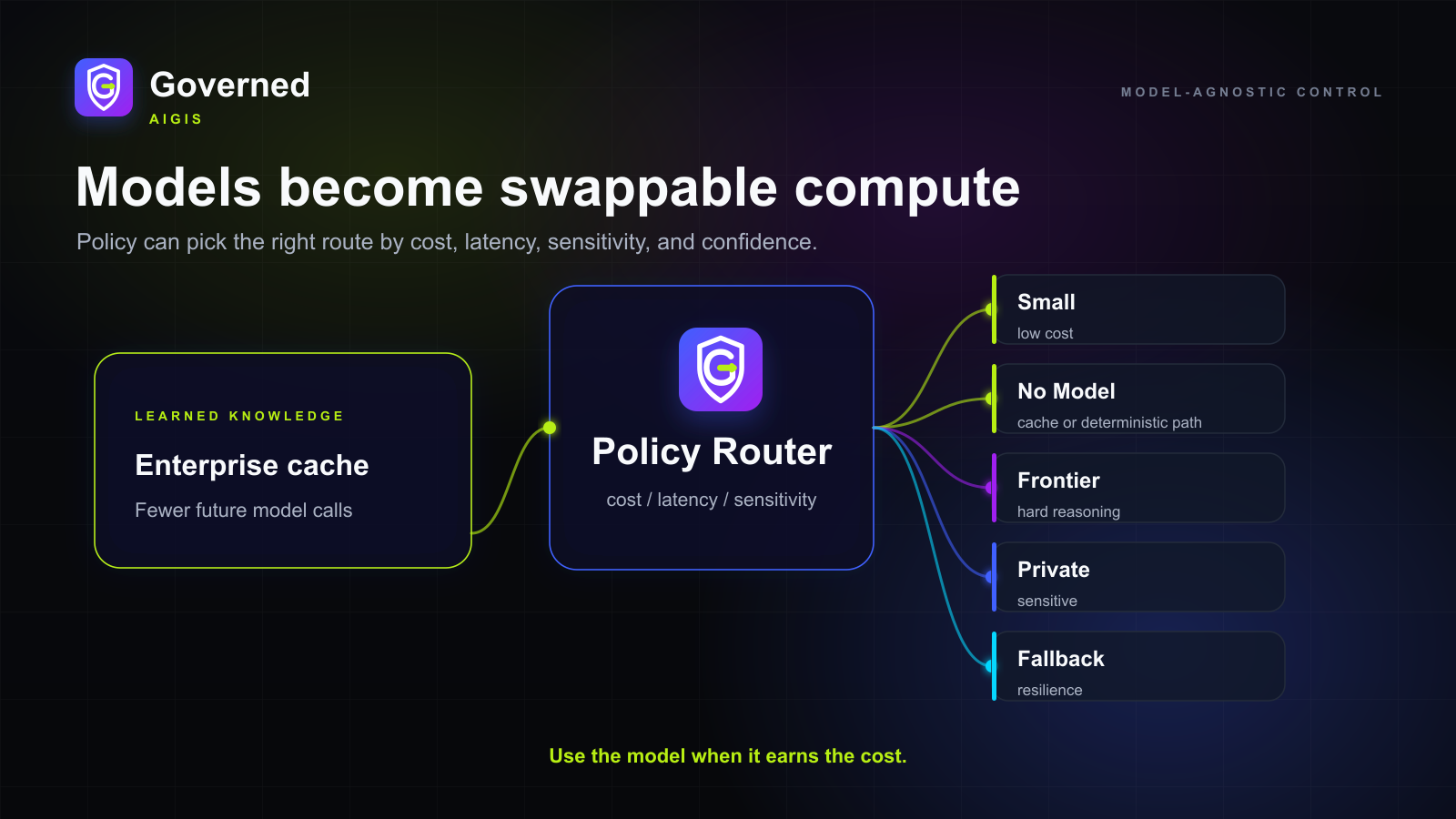
Vendor assistants monetize every interaction as an AI event. AIGIS treats LLMs as one execution option behind a governed router, so more enterprise knowledge means fewer expensive model calls.

Model-agnostic control
Policy routes requests by cost, latency, sensitivity, confidence, and whether a model is needed at all.
Sources: Salesforce and Microsoft publish list pricing. ServiceNow, SAP Joule, and MuleSoft are quote-based or consumption-based, so those ranges are industry estimates. Production model spend is paid through the customer's provider account; AIGIS reduces that spend with cache, direct API/database paths, and model routing policy.